Kardashev Type 2 Civilization: What It Is & Why It’s Possible

A Kardashev Type 2 civilization is one that can harness the total energy output of its star, roughly the power of the Sun for us. Nikolai Kardashev proposed the scale in 1964 to rank civilizations by energy use. Type 2 sounds impossible today, but that judgement is about our current timeline, not physics.
Cold Open: The Night a Swarm of Satellites Looked Like Science Fiction
The other night, I was playing with one of NASA’s live solar system viewers. It’s a simple tool, but it lets you do one thing that changes your perspective entirely: speed up time. I centered the view on Earth and pushed the clock forward, watching days, then months, then years fly by in seconds.
What emerged wasn’t the clean blue marble from the Apollo missions. It was a buzzing, intricate web. A dense shell of satellites began to encircle the planet, each tracing its own precise orbit. As the years accelerated, the web grew thicker, a man-made constellation wrapping the globe.
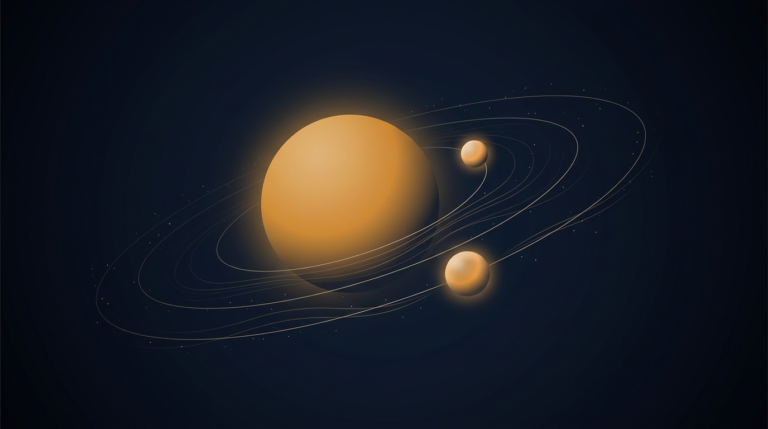
For a moment, it looked exactly like a miniature version of a Dyson swarm—the theoretical megastructure a Kardashev Type 2 civilization might build to capture its star’s energy. That idea had always felt like pure science fiction, a concept so vast it was functionally impossible. But watching that digital swarm coalesce around Earth, I realized I was looking at the real thing, in miniature. A planetary-scale infrastructure project, built piece by piece.
And it hit me. We dismiss Type 2 civilizations as impossible because we’re standing at the beginning of the timeline. We see the finished product and can’t imagine the process. But the process has already begun.
What is a Kardashev Type 2 civilization?
A Kardashev Type 2 civilization is a hypothetical society capable of capturing and utilizing the entire energy output of its home star. This means harnessing approximately 10^26 watts of power for a star like our Sun. It represents a level of technological and engineering mastery far beyond our own, enabling projects on a stellar scale.
What Is the Kardashev Scale?
The Kardashev scale is a method for classifying hypothetical civilizations based on their total energy consumption. It’s a thought experiment, not a rigid scientific law, but it provides a useful framework for thinking about the future of technology and humanity’s place in the universe.
Nikolai Kardashev and why energy is the yardstick
In 1964, Soviet astrophysicist Nikolai Kardashev was searching for signs of extraterrestrial intelligence. He needed a universal metric to categorize potential alien societies. What single factor would be true for any advanced civilization, regardless of its biology, culture, or politics?
His answer was energy.
The laws of thermodynamics are universal. Any civilization that grows and builds complex technology will require more and more energy to power its systems and overcome entropy. Energy consumption, Kardashev reasoned, is the most objective and fundamental measure of a civilization’s technological capability. It sidesteps all our human-centric biases about what “advanced” means.
Type 1, Type 2 and Type 3 in plain English
Kardashev originally proposed three tiers. The scale is logarithmic—each step up represents a colossal leap in power consumption.
- Type 1 Civilization: A planetary civilization. It can store and use all the energy available on its home planet. This includes all solar, wind, geothermal, and tidal power that reaches the planet’s surface, roughly 10^16 watts. They are masters of their world.
- Type 2 Civilization: A stellar civilization. It can harness the total energy output of its host star. This is about ten billion times the energy of a Type 1 civilization. They are masters of their solar system.
- Type 3 Civilization: A galactic civilization. It can control energy at the scale of its entire host galaxy, tapping into the power of billions of stars. This is, again, about ten billion times the energy of a Type 2 civilization. They are masters of their galaxy.
Later theorists have added Type 4 (controlling a universe) and Type 5 (controlling a multiverse), but these are purely speculative extensions. The original three remain the core of the discussion.
Where humanity sits today
We haven’t even reached Type 1 status.
Based on our current global energy consumption, humanity is what you might call a Type 0 civilization. The physicist Carl Sagan famously estimated our position on the scale in the 1970s, placing us at around Type 0.7. Using updated data, that number today is estimated to be around 0.73.
We are still primarily reliant on burning the dead plants and animals that constitute our planetary energy savings account—fossil fuels. We have only just begun to tap into the “live” energy income our planet receives from the Sun. Becoming a true Type 1 civilization, mastering our planet’s energy budget, is likely centuries away.
Defining a Type 2 Civilization
At its core, a Type 2 civilization is defined by its relationship with its star. It no longer passively receives a tiny fraction of the star’s light on its home planet. It actively manages the star’s entire output.
What ‘harnessing a star’s output’ actually means
This doesn’t mean putting a lid on the Sun. It means building infrastructure on a scale we can barely comprehend to intercept the energy that would otherwise radiate uselessly into space.
A star like our Sun emits energy in all directions. Earth only intercepts about one two-billionth of that total output. A Type 2 civilization wastes nothing. It builds a system of collectors to capture a significant portion, if not all, of that 360-degree radiation. This captured stellar energy would then be used to power a civilization spanning an entire planetary system, supporting unimaginable levels of computation, manufacturing, and population.
Characteristics of a Type 2 Civilization
What would such a society look like? While the specifics are unknowable, the physics involved gives us some strong clues. A civilization wielding this much power would have a distinct technological signature.
Fusion-scale energy, Dyson swarms and terraforming
The most famous theoretical technology of a Type 2 civilization is the Dyson sphere or, more plausibly, the Dyson swarm. Popularized by physicist Freeman Dyson, this isn’t a solid shell (which would be gravitationally unstable). It’s a dense cloud of independent satellites, solar collectors, and habitats orbiting a star, each capturing a piece of its energy and beaming it to where it’s needed.
To build such a structure, a civilization would need to deconstruct entire planets and asteroids for raw materials. This implies mastery over matter at a solar system scale.
Energy on this level also unlocks other capabilities. Fusion energy, which we struggle to sustain for seconds in massive reactors, would likely be a trivial power source for them. They could ignite and contain miniature stars at will. With near-limitless energy, terraforming—engineering the climate and geology of a dead planet like Mars to make it habitable—becomes a practical infrastructure project, not a theoretical dream.
How far is humanity from a Type 2 civilization?
Humanity is likely thousands, if not tens of thousands, of years away from becoming a Type 2 civilization. We are currently a Type 0.73 civilization, meaning we have not yet even achieved full mastery of our own planet’s energy resources (Type 1). The leap from Type 1 to Type 2 is ten billion times larger than the leap from our current state to Type 1.
Humanity’s Path From Type 1 to Type 2
The road from here to there is long and fraught with peril. It’s not a single jump but a series of transformative steps.
First, we must become a true Type 1 civilization. This means transitioning completely to renewable energy sources, creating a global energy grid, and mastering technologies like large-scale energy storage and fusion power. This step alone could take centuries and requires unprecedented global cooperation.
Once planetary mastery is achieved, the focus would shift outward. The civilization would begin harvesting resources from the asteroid belt, the Moon, and other planets. This “industrialization of the solar system” is the necessary prerequisite for building the megastructures of a Type 2 society. The satellite swarm I saw in the NASA viewer is the very first, embryonic stage of this process.
Beyond the Dyson Sphere: Other Ways to Use a Star’s Energy
A Dyson swarm is the most iconic image of a Type 2 civilization, but it’s not the only option. The goal is energy, and there are other theoretical ways to get it.
One concept is a stellar engine. This is a class of megastructures that uses a star’s energy not just for power, but for propulsion. A Shkadov thruster, for example, is a massive stellar-scale mirror that reflects a portion of a star’s radiation, creating a tiny but constant thrust. Over millions of years, this could move the entire solar system to avoid a cosmic catastrophe or to explore the galaxy.
Another use is for computation. Some theorists propose that the ultimate limit of computation is not processing power, but heat dissipation. A civilization could build a “Matrioshka brain”—a series of concentric Dyson spheres that use the star’s energy for computation, with each outer layer using the waste heat of the inner layer as its power source. This would be a computer the size of a solar system.
Why Type 2 Is So Hard: Logistics, Waste Heat and Societal Complexity
The challenges of becoming a Type 2 civilization are not just technological. They are logistical, physical, and societal.
Logistics: Building a Dyson swarm would require dismantling planets. Imagine the project management required to mine Mercury and Venus for raw materials and transport them into solar orbit. The sheer scale of resource acquisition and construction is mind-boggling. The cloud has a body, and the body of a Type 2 civilization is an entire solar system.
Waste Heat: The second law of thermodynamics is absolute. Any system that does work produces waste heat. A civilization using the entire output of a star would generate an astronomical amount of it. This heat must be radiated away, likely in the infrared spectrum. Managing this thermal load without cooking the civilization’s habitats is a monumental engineering problem.
Societal Complexity: Can a single civilization even survive the transition? The energy and resources available would be practically infinite. This could lead to a post-scarcity utopia, or it could create unimaginable conflict. Is a society that can move stars capable of governing itself without self-destructing? This may be the ultimate Great Filter. A civilization might be more likely to succumb to internal collapse than to an external threat.
How would we detect a Type 2 civilization?
We would detect a Type 2 civilization not by listening for radio signals, but by looking for the physical evidence of its engineering. The most prominent sign would be a massive infrared signature. A Dyson swarm would block a star’s visible light but would have to radiate its waste heat, causing the star to glow brightly in the infrared spectrum.
How We Might Detect a Type 2 Civilization
SETI (the Search for Extraterrestrial Intelligence) has traditionally focused on listening for communications. But the search for Type 2 civilizations is a search for artifacts.
The most obvious method is looking for infrared signatures. A star encased in a Dyson swarm would appear unusually dim in the visible spectrum but would be a powerful source of infrared radiation. Searches for these “IR-excess” objects are ongoing.
Another method is looking for odd stellar dimming. A large, non-uniform swarm of collectors would cause the star’s light to flicker and dim in strange, aperiodic ways as different parts of the structure pass in front of it. The famous case of Tabby’s Star (KIC 8462852), which exhibited bizarre and extreme dips in brightness, led some to speculate it could be an alien megastructure, though natural explanations are now favored. Still, it showed us what to look for.
Type 2 and the Fermi Paradox: Where Is Everybody?
The Kardashev scale adds a sharp edge to the Fermi Paradox. Our galaxy is billions of years old. There has been more than enough time for countless civilizations to arise and, for at least a few of them, to reach Type 2 or even Type 3 status.
A Type 2 civilization would be highly visible. A Type 3 would be unmissable, fundamentally altering the appearance of its host galaxy. Yet we look at the sky and see nothing. No stellar engines moving stars, no galaxies glowing with waste heat.
This silence is unnerving. Does it mean no one else is out there? Or does it suggest that the transition to Type 2 is a “Great Filter”—a barrier so difficult to overcome that no civilization (or very few) ever makes it? Perhaps they destroy themselves, or perhaps the engineering is truly impossible. Or maybe they exist, but in a form we can’t yet recognize.
Is a Type 2 civilization actually possible?
From a purely physical standpoint, a Type 2 civilization appears to be possible. No known laws of physics forbid the construction of megastructures like a Dyson swarm to harness a star’s energy. The primary obstacles are not physical but are instead immense challenges of engineering, logistics, resource management, and long-term societal stability.
Common Misconceptions About Type 2 Civilizations
Science fiction has filled our heads with images of empires and star fleets. The reality, if it exists, is probably stranger.
One misconception is that they would be just like us, but with better toys. A society that has existed for the tens of thousands of years required to reach Type 2 status would likely be post-biological, existing as pure information in a computational substrate like a Matrioshka brain. Their goals and motivations might be completely incomprehensible to us.
Another is that they would be eager to communicate. Why would they be? The gap between us and them would be greater than the gap between us and an ant colony. They may not even perceive us as intelligent, or they may have an ethical policy of non-interference. Their existence might be a quiet, internal one, focused on computation rather than exploration.
The Impossibility Horizon: Why ‘Impossible’ Describes Our Position in Time
When we look at the concept of a Dyson swarm, our minds default to “impossible.” The scale is too big, the materials required too vast, the timeline too long.
This is a failure of perspective. We are judging a project that takes millennia from the viewpoint of a society that plans in quarterly reports. “Impossible” is not a statement about physics. It is a statement about our current position on the timeline.
A thought experiment: what would early humans have said about harvesting a whole planet’s energy?
Imagine explaining a global power grid to a small band of hunter-gatherers 50,000 years ago. You tell them that their distant descendants will build a planetary web that captures the energy of lightning, the heart of the Earth, and the light from the sky, channeling it into glowing rocks in every home to power thinking machines.
They would not call you a visionary. They would call you insane. It would be, from their perspective, utterly and completely impossible. They lack the concepts for electricity, for global infrastructure, for computation. Their “impossibility” is a function of their conceptual toolkit. Our judgment of a Type 2 civilization is no different.
The satellite swarm around Earth as a small, real example of orbiting infrastructure at planetary scale
That swarm of satellites I saw is the proof. We are, right now, building a planetary-scale orbital structure. Piece by piece. No single person or nation is “building the satellite swarm.” It is an emergent property of our technological growth. It is happening slowly, over decades, with each launch adding one more node to the network.
A Dyson swarm would likely be built the same way. Not as a single grand project, but as the slow, emergent result of a civilization’s expansion over thousands of years.
Paired contrast: ‘impossible’ (no known law forbids it) vs ‘not yet’ (we lack the tools)
This is the critical distinction for any thinker. We must separate what is truly impossible from what is merely “not yet.”
- Impossible: Violates a known, fundamental law of physics. A perpetual motion machine is impossible. Faster-than-light travel (as we currently understand spacetime) is impossible.
- Not Yet: Permitted by the laws of physics, but currently beyond our engineering, material, or social capacity. Curing aging is “not yet.” Interstellar travel is “not yet.” A Kardashev Type 2 civilization is “not yet.”
Confusing these two categories is one of the most common loops the mind gets stuck in. It builds a wall where there is only a horizon.
What to Take From It: Thinking Beyond Your Own Horizon
This isn’t just an abstract discussion about aliens and megastructures. It’s a powerful metaphor for how we think about our own limitations.
Every time you say “I could never do that” about starting a business, writing a book, or changing your career, you are staring at your own personal impossibility horizon. Your mind is doing the same thing we do when we look at a Dyson swarm: it sees the finished product and dismisses it because it cannot yet map the thousands of small, achievable steps that lead there.
The work is to see the “not yet” for what it is. To break down the “impossible” goal into the first, simple, physically possible step. Then the next one. This isn’t about hype or motivation. It’s about a mechanical process of deconstructing the mental walls that our own conditioning has built. To see beyond them, you first have to recognize the conditioning that creates them. We wrote our guided journal, The Art of Un-Conditioning Your Mind, as a practical guide to dismantling those walls.
The lesson of the Kardashev scale is that scale is a function of time and compounding effort. What looks like a miracle from a distance is just engineering up close. The same is true for the projects of your own life.
If this way of thinking—breaking down big ideas to their first principles and redesigning your own mental models—resonates with you, a great place to begin is with our book, The Art of Un-Conditioning Your Mind. It provides the frameworks for this exact process.
FAQ
What is the Kardashev scale?
The Kardashev scale is a system proposed by astrophysicist Nikolai Kardashev in 1964 to classify hypothetical civilizations based on the amount of energy they are able to use. It has three main types: Type 1 (planetary), Type 2 (stellar), and Type 3 (galactic).
What is a Type 1 civilization?
A Type 1 civilization can access and control all the energy available on its home planet, including solar, wind, geothermal, and other renewable sources. Humanity is currently not yet a Type 1 civilization.
What is a Type 3 civilization?
A Type 3 civilization is a society that can harness the energy output of its entire galaxy, controlling the power of billions of stars. This level of development is purely theoretical and vastly beyond a Type 2 civilization.
Could a Dyson sphere actually be built?
A solid, rigid Dyson sphere is likely impossible due to immense gravitational and structural stress. However, a “Dyson swarm”—a dense but independent cloud of orbiting solar collectors and habitats—is considered more physically plausible, though still a monumental engineering challenge.