Dyson Swarm: What It Is & How It Works (An Explainer)

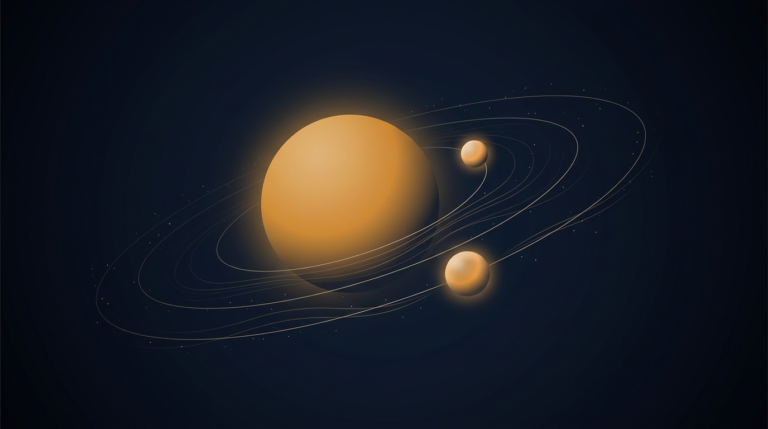
A Dyson swarm is a hypothetical megastructure made of huge numbers of independent solar collectors orbiting a star to capture its energy. Unlike a rigid Dyson sphere, it can be built piece by piece. Physicist Freeman Dyson floated the idea in 1960.
Cold Open: Speeding Up Time on NASA’s Live Solar System View and Watching Earth Vanish Inside Its Own Satellites
Go to any real-time 3D map of the satellites orbiting Earth. At first, you see our familiar blue marble, serene and alone. Then, you start to toggle on the data layers: active satellites, rocket bodies, debris. The space around our planet becomes visibly populated, a faint haze of individual objects, each on its own precise path.
Now, speed up time. As the simulation accelerates, those individual points blur. The distinct paths merge into a shimmering, chaotic web. Faster still, and the web solidifies. The planet itself disappears behind a cage of our own making, a cloud of machinery we sent up piece by piece.
This is the swarm principle in miniature. It’s a visceral demonstration of how thousands of small, independent parts can coalesce into a single, planet-encompassing system. We think of the cloud as ethereal, but the cloud has a body. Our digital existence is built on this growing physical infrastructure in orbit. And this small-scale reality is the best model we have for one of the grandest ideas in theoretical engineering: the Dyson swarm.
What is a Dyson swarm?
A Dyson swarm is a hypothetical megastructure composed of a vast number of independent solar collectors and habitats orbiting a star. The goal is to capture a significant portion of the star’s total energy output. Each collector, or satellite, would be its own orbiting power station, converting stellar energy into a usable form and beaming it to where it’s needed.
Unlike its more famous cousin, the Dyson sphere, a swarm is not a solid object. It’s a dense, disorganized cloud of components, each on its own unique orbit. This makes it a far more plausible engineering project for an advanced civilization.
Freeman Dyson and the 1960 idea
The concept originates with physicist and mathematician Freeman Dyson. In his 1960 paper “Search for Artificial Stellar Sources of Infra-Red Radiation,” Dyson wasn’t providing a blueprint. He was proposing a thought experiment. How could a civilization meet its exponentially growing energy needs?
He reasoned they would eventually need to capture their star’s energy directly. The most logical way to do this was to disassemble a planet and use its mass to build a cloud of orbiting structures. Dyson imagined these as habitats, but the core idea of a swarm of solar collectors remains. His main point was that such a structure would be detectable from Earth by its unique infrared signature—the waste heat generated by its countless components.
Dyson swarm in real science vs fiction and games
There is a sharp divide between the scientific concept and its popular depiction.
In science, the Dyson swarm is a messy, practical solution. It’s built incrementally, it’s not perfectly efficient, and it’s likely to be a partial, incomplete system for millennia. It’s a study in orbital mechanics, material science, and thermodynamics.
In science fiction and games, you’re more likely to see the Dyson sphere. A solid, rigid shell encasing a star is visually dramatic and conceptually simple. It’s a single, awe-inspiring object. Games often feature “Dyson Swarm Ground Units” or other simplifications that miss the point. The scientific swarm is about distributed systems; the fictional sphere is about monolithic power.
Origin and History: From Dyson’s Idea to Today
Freeman Dyson’s 1960 paper was a landmark in the nascent field of SETI (Search for Extraterrestrial Intelligence). He gave astronomers a specific, physically plausible artifact to look for. Instead of listening for radio signals—which might be fleeting or nonexistent—we could look for the unavoidable thermodynamic byproduct of a super-advanced civilization: waste heat.
The idea was that any technological society is bound by the laws of physics. Energy cannot be created or destroyed, only converted. Capturing and using stellar energy on a massive scale would inevitably generate enormous amounts of heat that must be radiated away, likely in the infrared spectrum. A star encased in a swarm would look unusually dim in visible light but glow brightly in infrared.
For decades, the idea remained largely theoretical. But with the advent of powerful infrared telescopes and the discovery of exoplanets, searching for these “technosignatures” has become a small but active area of astronomical research. Scientists now scan large datasets for stars with anomalous infrared excess or strange dimming patterns that could indicate the presence of a megastructure.
Purpose and Energy Needs: Why Capture a Star?
Why would any civilization undertake a project of such staggering scale? The answer is simple: power. A civilization’s technological capabilities are fundamentally limited by the amount of energy it can command.
Our own energy consumption has grown exponentially since the Industrial Revolution. If a civilization continues to develop for thousands or millions of years, its energy needs would eventually outstrip every available source on its home planet—fossil fuels, nuclear, even planetary renewables. The only power source large enough to sustain continued growth is the parent star itself. The sun, for example, radiates about 3.8 x 10^26 watts of power. Earth intercepts only a tiny fraction of that—about one-billionth.
A Dyson swarm is the most direct way to start capturing the other 99.9999999%. It represents a species making the ultimate transition from planetary to stellar resources.
The link to the Kardashev scale
This concept is formalized in the Kardashev scale, proposed by Soviet astronomer Nikolai Kardashev in 1964. The scale classifies civilizations based on their energy consumption:
- Type I: A civilization that can harness all the energy available on its home planet (approximately 10^16 watts). We are currently around a Type 0.7.
- Type II: A civilization that can harness the total energy output of its parent star (approximately 10^26 watts). Building a Dyson swarm is the hallmark of a Type II civilization.
- Type III: A civilization that can harness the energy of an entire galaxy (approximately 10^36 watts).
The Dyson swarm is the technological bridge between Type I and Type II. It’s the engineering project that allows a civilization to make that leap.
What is the difference between a Dyson swarm and a Dyson sphere?
A Dyson swarm is a massive cloud of independent, orbiting solar collectors, while a Dyson sphere is a single, solid shell enclosing a star. The swarm is modular and can be built piece by piece over time. The sphere would have to be constructed all at once and would be gravitationally unstable.
This distinction is crucial. The swarm is a plausible, if monumental, engineering project. The sphere is, for all practical purposes, a fantasy.
| Feature | Dyson Swarm | Dyson Sphere |
|---|---|---|
| Structure | A dense cloud of many independent satellites/collectors. | A single, solid, rigid shell enclosing the star. |
| Construction | Incremental. Can be built one satellite at a time. | All-or-nothing. The entire structure must be completed to function. |
| Stability | Each component is on a stable orbit. Resilient to failure of individual parts. | Extremely unstable. It would not be gravitationally bound to the star and would drift into it. |
| Habitability | Individual components could be designed as rotating habitats (O’Neill cylinders). | The inner surface is not habitable (no gravity, direct radiation). A rotating outer surface is possible but complex. |
| Feasibility | Theoretically possible, though an immense engineering challenge. | Considered physically impossible due to material strength and stability issues. |
A rigid shell vs many independent collectors
The swarm represents a different philosophy of building. It’s an infinite game, not a finite one. A rigid sphere is a finite project: you either succeed and build the whole thing, or you fail. It is a single point of failure. One catastrophic crack and the entire structure is compromised.
The swarm is played for the purpose of continuing the play. You start with one collector. Then ten. Then a thousand. The system provides value from the very first unit and becomes more powerful with each addition. It is resilient. If one collector is destroyed by a micrometeorite, the other 999,999,999 units continue to function. This modular, decentralized approach is the only way such a megastructure could ever be realized.
Engineering Challenges
Building a Dyson swarm would be the most complex undertaking in the history of any civilization. The challenges are not just about scale, but about system design.
Construction, orbital stability, maintenance and communication
First, you need a method of incremental construction. You can’t build it on a planet and launch it. You need to process raw materials in space and have a fleet of automated factories building and deploying new collectors continuously for centuries.
Second, orbital mechanics become a nightmare. A billion satellites orbiting a star in a dense cloud creates an unprecedented risk of collision. Each unit would need its own propulsion to maintain a stable, non-intersecting orbit. The entire swarm would require a central traffic control system of unimaginable complexity, likely managed by an advanced AI, to prevent a chain reaction of collisions known as Kessler Syndrome on a stellar scale.
Finally, maintenance and communication are critical. Collectors will fail. They need to be repaired or replaced by autonomous drones. The entire network must communicate to efficiently manage power distribution and orbital positioning.
Materials and the mass problem
Where do you get the raw materials? A complete Dyson swarm would have a mass equivalent to a large planet. The most frequently cited source is a planet like Mercury. It’s close to the sun, rich in metals and silicon, and has no biosphere to worry about destroying.
An advanced civilization would need to develop the technology to systematically deconstruct an entire planet and feed its mass into the swarm’s construction pipeline. This process alone would require staggering amounts of energy—a classic chicken-and-egg problem that can only be solved by bootstrapping the swarm itself.
Environmental Impact and Feasibility: The Compromise Solutions
A common concern is the impact such a structure would have on the habitability of any planets within the system. If you build a dense swarm around the sun at Earth’s orbit (1 AU), you block the sunlight. Earth would freeze.
This has led many to dismiss the idea. But that’s a failure of imagination, projecting a simplistic outcome onto a complex system. Nobody would build a swarm that kills their home world. The real question is about compromise.
A partial swarm and its effect on a planet’s temperature
Recent modeling, highlighted in a 2024 study published in Monthly Notices of the Royal Astronomical Society, explores these compromises. The researchers found that while a dense swarm at 1 AU would be catastrophic for Earth’s climate, the outcome changes dramatically if you alter the design.
A partial swarm, for instance, could be configured to leave a clear “gap” for Earth, allowing sunlight to pass through unimpeded. Another, more elegant solution is to build the swarm farther out. The study calculated that a swarm built at a distance of 2.13 AU (in the middle of the asteroid belt) could achieve a 99% solar energy capture rate while only causing Earth’s average temperature to drop by about 3 Kelvin. This is a significant change, but potentially manageable with climate technology. It turns an existential threat into a solvable engineering problem.
Could humans ever build a Dyson swarm?
Not with our current technology, or with any technology on the near horizon. The material, energy, and logistical requirements are orders of magnitude beyond our present capabilities. We are a Type 0.7 civilization; this is a Type II project.
However, it is not physically impossible. The swarm does not violate any known laws of physics. It is an engineering problem of scale, not of principle. To even begin contemplating such a project requires a fundamental shift in how we think—away from short-term goals and toward projects that span generations. It requires a kind of mental un-conditioning from the immediate and the quarterly.
This is the kind of thinking we explore in our guided journal, The Art of Un-Conditioning Your Mind. It’s about building the mental architecture required to tackle problems that seem impossible from our current vantage point.
Other Dyson Structures: Bubble, Shell and Ring
While the swarm is the most plausible design, Dyson and others have imagined different configurations for stellar-scale megastructures.
- Dyson Bubble: This concept uses “statites”—satellites that are not in orbit but are held up against the sun’s gravity by the pressure of its own light (solar radiation). Each statite would be a massive but incredibly thin solar sail. The advantage is that they don’t need orbital velocity, but the material requirements are extreme.
- Dyson Shell: This is the classic, sci-fi solid sphere. As discussed, it’s considered physically impossible due to immense tensile strength requirements and a lack of gravitational stability.
- Dyson Ring: A solid, rotating ring of matter around a star. This is a step toward a full sphere and is the concept behind Larry Niven’s famous Ringworld. It’s more stable than a full sphere but still a monumental challenge.
How Astronomers Could Spot a Dyson Swarm
If a Dyson swarm exists, it should be detectable. Freeman Dyson’s original paper was, after all, a guide for how to find one. There are two primary methods astronomers use.
The first is searching for an infrared signature. The solar collectors in a swarm would absorb visible light from the star, use it, and radiate the unusable excess energy as waste heat. This heat would glow in the infrared part of the spectrum. A star with a Dyson swarm around it would appear abnormally dim in visible light for its size but would be unusually bright in infrared.
The second method is looking for unusual transit dimming. When a planet passes in front of its star, it causes a small, regular, predictable dip in the star’s light. A cloud of swarm collectors would also block starlight, but in a much more chaotic and aperiodic way. Astronomers searching for exoplanets occasionally find stars that exhibit strange dimming patterns that don’t fit any known natural phenomenon, making them potential, if highly speculative, candidates for megastructures.
Ethics and Society of Building at Star Scale
Undertaking a project like a Dyson swarm raises profound ethical and societal questions. Who gets to decide to disassemble a planet? Who owns the energy produced? A project that takes thousands of years to build requires a level of social and political stability that humanity has never known.
It forces a species to operate on geological timescales, making decisions that will affect countless future generations. It would require a truly collective consciousness and a shared purpose that transcends individual nations, cultures, and lifetimes. The governance of such a project is a problem perhaps even harder than the engineering.
The Swarm Principle: Why Many Small Pieces Beat One Giant Structure
The core idea of the Dyson swarm is more than just a sci-fi concept. It’s a powerful design principle: resilience, scalability, and efficiency often come from a decentralized network of many small, simple components, not from a single, complex, monolithic entity.
We see this principle everywhere: in ant colonies, in the architecture of the internet, and in the neural networks of our own brains. It’s a fundamental pattern for building robust systems.
Earth’s crowded orbits as a small-scale swarm
This brings us back to the cloud of satellites orbiting Earth. Starlink, OneWeb, and other satellite constellations are a real-world test of the swarm principle. They are built incrementally. The network provides value from the first satellite launched and grows more powerful with each addition. They demonstrate how thousands of objects can be managed in a complex orbital dance.
They are, in effect, a planetary-scale swarm for communication, not a stellar-scale swarm for energy. But the underlying logic is the same.
What the satellite swarm teaches, and where the analogy breaks
Our growing satellite constellation teaches us invaluable, and sometimes painful, lessons. It proves that incremental, modular construction in orbit works. It also teaches us that managing orbital traffic is incredibly difficult and that debris and congestion are serious threats that can trigger a cascade of failures.
The analogy breaks down in two key areas: purpose and scale. Our satellites orbit a planet to reflect or transmit information. A Dyson swarm orbits a star to capture its raw power. The energy involved, the mass required, and the timescales are not just bigger; they are in a completely different physical category. Our satellite swarm is like a child’s drawing of the sun; a Dyson swarm is the sun itself.
Are the satellites around Earth a Dyson swarm?
No, the thousands of satellites orbiting our planet do not constitute a Dyson swarm. A Dyson swarm is a specific type of megastructure designed to orbit a star to capture its energy. Our satellites orbit a planet, and their primary purposes are communication, observation, navigation, and science, not large-scale energy capture.
However, our satellite constellations do operate on a similar swarm principle: a large number of independent, orbiting objects working together as a single system. They provide a valuable, small-scale analogy for how a true Dyson swarm might be built and managed.
FAQ
How much energy could a Dyson swarm capture?
A complete Dyson swarm could theoretically capture nearly 100% of its star’s total energy output. For a star like our sun, this amounts to roughly 384 yottawatts (3.84 x 10^26 watts), which is trillions of times humanity’s current energy consumption.
How long would it take to build a Dyson swarm?
Estimates vary wildly, but it would not be a short-term project. Given the need to deconstruct a planet for materials and build the swarm incrementally, the construction would likely take many centuries, if not millennia, even for a highly advanced civilization.
Is a Dyson swarm the same as a Ringworld?
No. A Ringworld, from Larry Niven’s novel of the same name, is a specific type of Dyson ring—a solid, spinning structure one million miles wide with a diameter roughly equal to Earth’s orbit. A Dyson swarm is a non-solid cloud of many separate collectors.
Could a Dyson swarm be used as a weapon?
Theoretically, yes. A civilization capable of building a Dyson swarm would command enough energy to power planet-scale weapons or manipulate stellar physics. The ability to focus even a tiny fraction of a star’s output would be a weapon of unimaginable power.
Building at this scale is less about technology and more about the thinking behind it. It requires a mind that can design systems, play infinite games, and see past immediate limitations. If you’re a founder, creator, or professional who wants to build that kind of mind, our guided journal, The Art of Un-Conditioning Your Mind, is designed to help you deconstruct your mental defaults and build new ones.